1.Weiss Hills Passover Seder 2026
Gowanus Haggadah
Cocktail hour begins at 5:30.
The seder will begin around 6:30.
2.Welcome
Here we are. Here we are, gathered to celebrate the oldest continually practiced ritual in the Western world, to retell what is arguably the best known of all stories, to take part in the most widely practiced Jewish holiday. Here we are as we were last year, and as we hope to be next year. Here we are, as night descends in succession over all of the Jews of the world, with a book in front of us.
The Torah is the foundational text for Jewish law, but the Haggadah is our book of living memory. And the Torah commands us to perform the mitzvah of telling this story: “You shall tell the Pesach story to your children in the days to come.” However, we are not merely telling a story. We are being called to a radical act of empathy. But what does that mean—a radical act of empathy?
There are many different characters in the Passover story, and it’s common for us to put ourselves in the shoes of our Jewish ancestors, slaves in Egypt, and to channel the bitterness and oppression they must have felt. But there were others there as well: Jochabed, the mother of Moses, who summoned the courage to save her son; Pharaoh, a ruler who saw Egypt as the center of the world and cultivated distrust of the Jews, leading to their enslavement; the Egyptian populace, who experienced the plagues and lost their children; the daughter of Pharaoh, who saved Moses from the river and raised him as her own; the soldiers drowned in the Red Sea; and the families in Egypt who would never see them again.
To separate ourselves and our empathy from these other characters is to do a disservice to the telling of the story. Throughout history, the Passover story replays itself again and again. The characters remain the same—but the cast changes.
Why do we tell this story every year? Is it to remember only our own oppression? Instead, I would like to propose that tonight we consider: what are the lessons the Passover story imparts to us, how do they apply to the world we live in today, and what is our role?
3.The Table
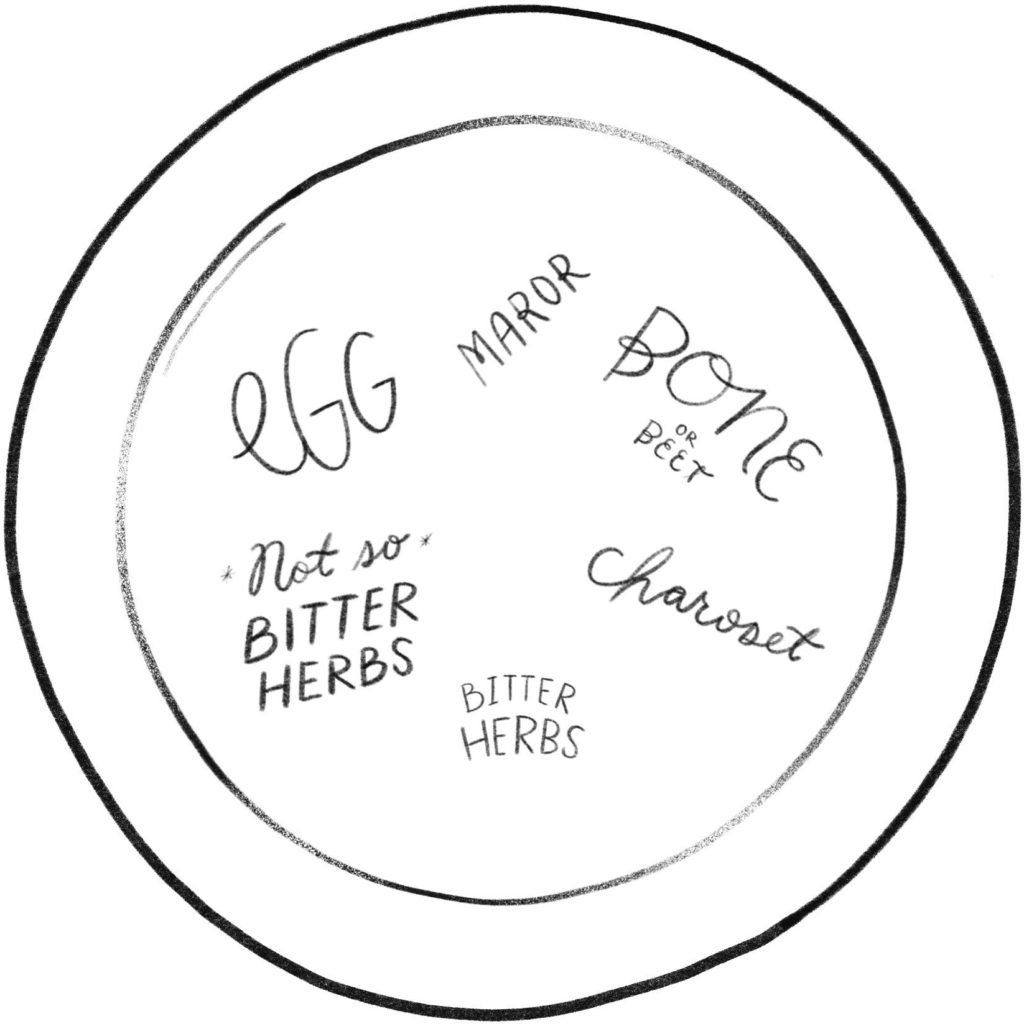
At the head of the table is a seder plate on which the following foods have been placed:
ZEROA
A roasted bone. This can be either a shank bone, the neck of a chicken, or a beet if we’re going for a vegetarian seder plate. The Zeroa reminds us of the special lamb that was offered on Pesach in the ancient temple in Jerusalem.
BETZAH
A roasted egg. In ancient days, on each of the three pilgrimage festivals (Pesach, Shavuot, and Sukkot) a sacrifice was offered in the temple in honor of the holiday. The roasted egg reminds us of that offering.
MAROR
Bitter herbs, usually horseradish. This is a reminder of the bitterness and hardship of slavery in Egypt.
CHAZERET
Bitter herbs, like romaine lettuce. This is also a reminder of the bitterness and hardship of slavery in Egypt.
CHAROSET
Traditionally a mixture of chopped apples, nuts, cinnamon, and red wine. This reminds us of the clay used with the mortar by the Jews when they made the bricks for the pyramids which they built for Pharaoh.
KARPAS
Some greens, usually parsley. The Karpas is a reminder of springtime, the season of Pesach, when nature blooms again and awakens our hope.
ORANGE
In the 1980s, Susannah Heschel, a Jewish feminist scholar, chose to include an orange at her seder to symbolize the inclusion of LGBTQ+ individuals alongside other marginalized groups.
The seder table also has:
Three whole matzos wrapped together. Matzo commemorates the bread which our forefathers were compelled to eat during their hasty departure from Egypt. We use three matzos to represent the three religious groupings of the Jewish people—Kohen, Levi, and Yisrael. They are placed together to indicate the unity of the Jewish people. In unity, we find our strength and the power to survive.
Wine. During the course of the seder we drink four cups of wine. Wine is the symbol of joy and thanksgiving. The four cups represent the four-fold promise which the Lord made to the Jews in Egypt. In the following words, the Lord assured them that they would be freed from slavery: “I will bring you forth;” “I will deliver you;” “I will redeem you;” “I will take you.”
Salt water. Use this for the dipping of the Karpas, representing the tears shed by the Jews in slavery.
Cup of Elijah. A large wine cup is in the center of the table in honor of the prophet Elijah.
Cup of Miriam. A larger cup of water is in the center of the table in honor of Miriam, Moses’s sister. Her well followed the Jewish people on their journey through the desert so they would have water.
4.Candle Lighting
As we light these candles in honor of Pesach, we hope that their brightness and warmth may bring joy and hope to us and to all our dear ones.
Baruch Ata Adonia, Eloheinu melech ha-olam, asher-kid’shanu b’mitsvotav v’tsivanu l’hadlik neir shel Yom Tov.
Blessed are You, Lord our God, Creator of the Universe, who makes us holy with mitzvot and commands us to kindle the festival lights.
5.What to Expect Tonight
The Passover seder is conducted in an orderly fashion, with each ritual performed at a certain time, in a certain way, according to thousands of years of tradition. This is surprising, as the Jewish people—while we do have a history of being particularly good at community organizing—we do not have a history of being particularly well organized. Even God Themself often seems engaged in convolution, a phrase which here means “as if They have not quite followed Their own plan.” If you look around the Passover table now, you will most certainly see the muddle and the mess of the world. There is likely a stain someplace on the table cloth, or perhaps one of the glasses has a smudge. Soon things will be spilled. You might be sitting with people you do not know very well, so your own emotional state is somewhat disordered. Nobody likes everything served at the Passover dinner, so there will be chaos within people’s palates, and the room is likely to be either too cold or too hot for someone, creating a chaos of discomfort. Perhaps there is someone who has not yet sat down, even as the seder is beginning, because they are “checking on the food,” a phrase which here means “sneaking a few bites” when they’re supposed to be participating in this ceremony.
This is as it should be. Passover celebrates freedom, and while the evening will proceed in a certain order, it is the muddle and the mess around the order that represent the freedom that everyone deserves, and that far too many people have been denied. With that in mind, why not excuse yourself, in an orderly fashion at some point in the ceremony, so that you might check on the food?
Even though we have a roadmap, everyone should feel free to ask questions and offer their personal thoughts and stories as we reflect on how the Passover saga relates to today and our lives.
6.The Kiddush (First Cup (of Four))
We have come together to celebrate the oldest holiday on the Jewish calendar. Tonight we celebrate the story of the Jewish people, who are linked throughout time with all peoples in the passion for justice and human liberty. As we retell the story of our ancestors going out from slavery to freedom, may we learn to appreciate more deeply the freedom we enjoy. May we also learn to care about all those who are not yet free. May we join in working for the day when all people everywhere shall be free from poverty, from oppression, and from war.
Here we are, prepared and ardent, allied and present, ready to perform the mitzvah of the first cup, the enactment of salvation’s promise. As the Holy One, Blessed is They, declared: “And I will lift you out from under the millstone that is Egypt.”

(Raise your glass of wine)
Baruch Ata Adonai, Eloheinu melech haolam, borei p’ri hagafen.
Blessed are You, Lord our God, Sovereign of the Universe, Creator of the fruit of the vine.
Blessed are You, Lord our God, Creator of the Universe, who sanctified us with Your mitzvot. And it is with love that You gave us holidays for our happiness, that You gave us festivals and seasons to rejoice, that You gave us the Sabbath, that You gave us the day of this Festival of Matzot in the season of our emancipation, and designated it as holy—a commemoration of the Exodus from Egypt.
Baruch Ata Adonai, Eloheinu melech haolam, shehecheyanu, v’kiy’manu, v’higianu laz’man hazeh.
Blessed are You, Lord our God, Creator of the Universe, who has given us life and sustenance, and kept us alive, and has brought us to this moment.
(While reclining to the left, drink at least most of the first cup of wine.)
7.Urchatz (First Hand-Washing)
We wash our hands so that they will be clean and ready to do the special work required by our Passover seder—the handling of matzo, karpas, and the dipping of our fingers into our wine. We wash twice over the course of the night—this first time with no blessing. Typically, Urchatz is performed by pouring water over your hands from a pitcher held over a bowl but instead we can just use the sinks.
(Wash your hands.)
8.Karpas
Even before the Exodus from Egypt, each spring our people celebrated creation and the mystery of life. As we did then, we now remind ourselves that both the tender greens of the earth and the salts of the sea are joined together to sustain life. We remind ourselves that in slavery the salt of our tears released our strength to survive.
(Everyone takes a portion of greens and dips them in salt water. All recite the blessing.)
Baruch Ata Adonai, Eloheinu melech haolam, borei p’ri ha-adama.
Blessed are You, Lord our God, Ruler of the Cosmos, who creates the earth’s harvest.
(Eat greens dipped in salt water.)
9.Yahatz
(Uncover the matzos)
The matzos represent the Jewish people and hope of freedom for all, particularly those still living in tyranny and oppression.
Since the Passover sacrifice of a lamb was no longer possible after the destruction of the second Temple in 70 C.E., a matzo, in addition to the bone (or beet), came to represent the lamb.
(Break the middle matzo into two. Wrap the larger part—the afikoman—and set it aside for guests to try to steal during the seder and dinner. Return the smaller piece to between the two whole matzos and cover.)
First it is the custom to divide the matzo of freedom in two. One part we keep here with the rest of the matzos. The second part, the afikoman, is traditionally hidden somewhere in the house and after dinner, the children would search for it. The finder would then be rewarded and the two halves put together again. However, in our family, it has always been tradition for the leader of the seder to put the afikoman between two pillows right next to them and encourage guests to try to steal it without the host noticing. After dinner, we would then negotiate so that the afikoman can be reunited with its other half, we all eat some of it, and we finish the seder.
10.Magid
(Uncover the matzos)
This is the poor man’s bread that our fathers ate in the land of Egypt. All who are bent with hunger, come and eat; all who are in dire straits, come share Passover with us. This year there are those in the world who are not yet free, next year may all be liberated.
It is altogether proper that matzo is called the bread of affliction, because it has been afflicted more than any other foodstuff on earth. It is born in a searing-hot oven and then completely ignored for fifty-one weeks of the year while people walk around shamelessly eating leavened bread and crackers. Then, Passover rolls around, and it is smeared with various substances, ground up into balls, and, in the morning, fried up into a counterfeit version of French toast. Everyone eats it and nobody likes it, and there’s always one last box that sits untouched in a cupboard for months afterward, lonely, broken, and utterly unloved.
11.The Four Questions
(The following four questions are asked by a child or the youngest able participant)
What makes this night different from all other nights?
On all other nights we eat chametz and matzo. Why on this night do we eat only matzo?
On all other nights we eat vegetables of all types. Why on this night do we eat only maror?
On all other nights we don’t dip—not even once. Why on this night do we dip twice?
On all other nights we eat either sitting up or leaning back. Why on this night do we all lean?
This night is indeed different from all other nights of the year because on this night we remember one of the greatest dramas in Jewish history—the exodus from Egypt—second only to the Spanish Inquisition scene in Mel Brooks’s History of the World, Part One.
The first question asked concerns the use of matzo. We eat these unleavened cakes to remember that our ancestors, in their haste to leave Egypt, could not wait for breads to rise, and so removed them from the ovens while still flat.
We partake of the maror on this night so that we might taste bitterness, to remind ourselves how bitter it is to be caught in the grip of slavery as we were in Egypt.
We dip twice in the course of the seder, greens in salt water and maror in charoset, first to replace tears with gratefulness, and again to sweeten bitterness with suffering.
The fourth question asks why, on this night, we eat in a reclining position. To recline at mealtimes in ancient days was the sign of a free person. On this night of Pesach, we demonstrate our sense of complete freedom by reclining during out meal.
12.~~~~~~~~
Slaves is what we were—slaves to Pharaoh in Egypt. And, as the story goes, we were wrested free by the Lord God-of-Us, lifted out of that place in the mighty hand of an outstretched arm. And if the Holy One, blessed is They, had not taken our mothers and fathers out of Egypt, then what of us? We, and our children, and our children’s children, would be enslaved to Pharaoh of Egypt. Even if we were all learned, enlightened, rich with the wisdom of old age, and well versed in the Torah, still the obligation to tell of the Exodus from Egypt would rest upon us. All who are expansive in their telling of the Exodus from Egypt are worthy of praise.
13.The Four Children
As we tell the story, we think about it from all angles. Our tradition speaks of four different types of children who might react differently to the Passover seder. It is our responsibility to to make our story accessible to all so we think about how we might best reach each type of child.
The wise child, what do they say? “What are the testimonies and laws which God commanded you follow?” It falls upon us to guide them through all the obligations of Pesach.
The evil child, what do they say? “What does this type of worship mean to you?” To you and not to him, her, them, or us. We should admonish this child as one who is not concerned about the laws personally, but only for others. Traditionally, we’re told this child would have been left behind in Egypt and not worthy of God saving them. Perhaps we should consider if this is a failing of the teacher instead. The exchange reminds us to continue to engage across generations, share our traditions and, in return, be open to new perspectives.
The uninformed child, what do they say? “What is this?” To this child, answer plainly, “With a strong hand God took us out of Egypt where we were slaves.”
And to the child who does not know how to ask, you should help them ask by telling the story, “It is because of what God did for me in taking me out of Egypt.”
All four instances remind us that everyone is on their own personal journey of learning and understanding. We cannot expect all around us—especially those who are uniformed or don’t even know how to ask—to be on the same page. We must be open and encouraging. We must also be aware that—while we are very old and wise about many, many things—there are times when we are in the position of each of these children. Not only in regards to our relationship with Judaism, but in the face of other challenging and complex topics. Maybe the evil child has a point in their questioning.
14.~~~~~~~~
Some scholars believe there are four kinds of parents as well.
The wise parent is an utter bore. “Listen closely, because you are younger than I am,” says the wise parent, “and I will go on and on about Jewish history, based on some foggy memories of my own religious upbringing, as well as an article in a Jewish journal I have recently skimmed.” The wise parent must be faced with a small smile of dim interest.
The evil parent tries to cram the story of our liberation into a set of narrow opinions about the world. “The Lord led us out of Egypt,” the wicked parent says, “which is why I support a bloodthirsty foreign policy and am tired of certain types of people causing problems.” The wicked parent should be told in a firm voice, “With a strong hand God rescued the Jews from bondage, but it was my own clumsy hand that spilled hot soup in your lap.”
The uninformed parent does not grasp the concept of freedom. “There will be no macaroons until you eat all of your brisket,” says the ignorant parent, at a dinner honoring the liberation of oppressed peoples. “Also, stop slouching at the table.” In answer to such statements, the wise child will roll their eyes in the direction of the ceiling and declare, “Let my people go!”
The parent who is unable to inquire has had too much wine, and should be excused from the table.
15.~~~~~~~~
Long ago God promised Abraham that he would be the father of a great people who would be a blessing to the world. God also promised to watch over the Jewish people. In every generation there are those who rise against us to annihilate us.
(Everyone lifts their glasses of wine)
We now lift our cups of wine and thank God for Their faithfulness in keeping Their promise.
(Put down your wine without drinking)
16.The Passover Story
The story of the Jewish people in Egypt begins with Joseph. When Joseph succeeded in interpreting Pharaoh’s dreams, Pharaoh rewarded him by appointing him prince over the land. In that position, Joseph helped Egypt to survive during the year of hunger which he predicted would come. In fact, Joseph served Egypt so well that all the neighboring countries had to buy food from Egypt when the famine came.
The hunger in Eretz Yisrael also brought Jacob and his family to Egypt. They were seventy people in all. As time went by, they grew in number until it seemed that they were everywhere.
After Joseph died, a new Pharaoh arose. He disregarded the great contribution which Joseph had made to Egypt. He issued harsh decrees against the Jews, made slaves out of them, and even ordered every baby boy born to the Jews be put to death.
One such baby boy was saved from Pharaoh’s evil decree by his mother Jochebed’s courage and love. His name was Moses. By a strange twist of events, he was raised in the Pharaoh’s palace. There he could have lived peacefully and happily, enjoying the wealth, the protection and the excitement of the palace.
But Moses saw the suffering of the Jewish slaves and he felt the pain in his heart for them. One day when we saw an Egyptian taskmaster beating an Jewish slave, Moses could not control his anger. He killed the Egyptian. Moses now had to run away from Egypt. He fled to Midian where he became a shepherd.
17.~~~~~~~~
God forgets. A shocking idea: God chose us, and then forgot us. Only by wailing at the whips of our taskmasters and the death of our children did we remind Them of our existence. But God’s problem is our problem as well. We’re masters of forgetting: about prejudice and unfairness, wars and genocides, hunger and misery. We’re busy; we’re overwhelmed; we’re callous. So what reminds us of injustice in the world? Wailing. Protest. Complaining. Suffering in silence is not a Jewish virtue. Complaining is a Jewish virtue, because dissatisfaction is a particularly Jewish characteristic. Sometimes we are dissatisfied by trivial matters, by issues of money and status and luxury. But one of the joys of being Jewish is membership in a group that is eternally dissatisfied with the way things are. We are, at our core, a messianic people. We dream of a better time, when the entire world will make the journey from slavery to freedom. And how will that journey begin? By opening our mouths.
Wherever people gather to express dissatisfaction with the way things are—on healthcare, on the environment, on taxes, on immigration, on civil rights and social policy and foreign policy—you will find Jews leading both sides of the same dispute. Throughout history, Jews have been agitators for change.
But the question arises: Do Jews who agitate so ardently for change do so as Jews, or because they are Jews? Is there something embedded in the Jewish cultural DNA—the memory of Moses’s calling, perhaps—that sparks a desire to change the world? Or is it just coincidence?
Overwhelmingly, they are driven by tikkun olam, a central tenet of the Jewish faith. Tikkun olam: repair the world. Whether that is through policy, social and environmental justice, or the arts, it is about interconnectedness. Rabbi Brian Besser of Congregation Beth Shalom in Bloomington, Indiana once said that Torah isn’t just the written word—it is the air we breathe; it is forests, mountains, and seas; it is life.
18.~~~~~~~~
“And the Lord heard our voices.” As it is written: “And God heard their wailing, and God remembered Their covenant, Their Abraham, Their Isaac, Their Jacob.”
One day, while Moses was looking after his sheep, he heard the voice of God calling to him from a bush. Moses answered, “Here I am.” Then, according to the Torah, God spoke to him in these words:
“I am the God of your fathers, the God of Abraham, the God of Isaac, and the God of Jacob… I have surely seen the suffering of My people in Egypt and I have heard their cry because of their taskmasters. So I have come to deliver them out of the hand of the Egyptians and to bring them up out of that land to a good and large land, a land flowing with milk and honey… Therefore come now and I will send you to Pharaoh that you may bring forth My people…out of Egypt.”
And so Moses went to Pharaoh and delivered God’s message, “Let my people go and if not I’ll smite your people dead. Let my people go.”
Despite Moses’s plea and the threat of God’s punishment, Pharaoh stubbornly refused to free the Jewish slaves. One plague after another was brought upon the Egyptians. After each one, Pharaoh would promise to obey God’s command. But as soon as the plague had passed and relief came, Pharaoh changed his mind. Only after the tenth and most horrible plague, the death of the first-born, did Pharaoh finally agree to let the Jews go.
19.The Ten Plagues










It is traditional to spill a drop of wine from our cups as we recite each plague. Our cup of rejoicing cannot be full if others are suffering, even if they are people we disagree with. The Talmud recounts that when the heavenly angels sang songs of praise to God as the Egyptians were drowning in the Sea of Reeds, God reprimanded them for celebrating the suffering of Their children: the Egyptians. Let us dip from the cup of wine for all that the Egyptians endured.
(While saying the name of each of the plauges, use a finger to transfer a drop of wine from the cup to the dinner plate.)
Blood
Frogs
Lice
A maelstrom of beasts
Pestilence
Boils
Hail full of fire
Locusts
Darkness
The killing of the firstborn
20.Dayaynu (It would have been enough)
(Call and response.)
If They had taken us out of Egypt, and had not punished the Egyptians…
…dayaynu.
If They had punished the Egyptians, and had not destroyed their idols…
…dayaynu.
If They had destroyed their idols, and had not killed their firstborn…
…dayaynu.
If They had killed their firstborn, and had not given us their possesions…
…dayaynu.
If They had given use their treasures, and had not divided the sea…
…dayaynu.
If They had divided the sea, and had not led us across on dry land…
…dayaynu.
If They had led us across on dry land, and had not drowned the Egyptians…
…dayaynu.
If They had drowned the Egyptians, and had not taken care of us in the desert for forty years…
…dayaynu.
If They had taken care of us in the desert for forty years, and had not fed us the manna…
…dayaynu.
If They had fed us the manna, and had not given us the Shabbat…
…dayaynu.
If They had given us the Shabbat, and had not brought us to Mount Sinai…
…dayaynu.
If They had brought us to Mount Sinai, and had not given us the Torah…
…dayaynu.
If They had given us the Torah, and had not brought us to the Land of Israel…
…dayaynu.
If They had brought us to the Land of Israel, and had not built the Holy Temple…
…dayaynu.
21.The Three Major Symbols of Pesach
All the symbols of the seder are important, but Rabbi Gamliel, who was a great religious leader more than 1,800 years ago, used to say that there are three major Pesach symbols and if you do not explain these symbols at the seder then you have not fulfilled your duty.
They are:
- The Pesach (or Paschal) Lamb
- Matzo
- Maror (or bitter herbs)
(Point to the roasted shank bone or beet on the seder plate)
What is the significance of the Paschal lamb which our ancestors ate in the days when the Temple was in existence? It serves as a reminder that the Lord “pasach”—or “passed over”—the homes of our mothers and fathers when They smote the first-born sons of the Egyptians because the lamb’s blood was smeared over our ancestors doorways.
(Hold up a piece of matzo)
What is the significance of matzo? It is the flat, unleavened bread which our mothers and fathers ate during their departure from Egypt, for in their haste they could not wait for the dough to rise.
(Point to the maror)
What is the significance of maror? It serves to remind us that the Egyptians embittered the lives of our ancestors, as the Torah relates: “And they made their lives bitter with hard service, in mortar and in brick, and in all manner of service in the field; in all their service, wherein they made them serve with rigor.”
22.~~~~~~~~
The story of Passover may seem very remote to us, as it happened thousands of years ago, when the oldest people at our seder table were very, very young. So many of the details of the story seem somewhat old-fashioned, such as the smearing of lamb’s blood over the doorway of one’s home, which has largely been replaced by signs warning away solicitors.
But, as we spoke of earlier, the story of liberation is one that is still going on. People all over the world continue to be literally and figuratively in bondage, and we wait and wait, as the Jews in Egypt waited and waited, for the day when freedom will be spread all over the world like frosting on a well-made cake, rather than dabbed on here and there as if the baker were selfishly eating most of the frosting directly from the bowl. The Passover story tells us about a journey towards universal freedom for all, and like most journeys, it is taking much longer than it ought to take, no matter how many times we stop and ask for directions.
23.Second Cup
Let us now raise the second cup of wine as we thank God for this beautiful festival of Pesach. It reminds us of Their great gift of freedom to our ancestors and to us.
(Raise your glass of wine)
Baruch Ata Adonai, Eloheinu melech haolam, borei p’ri hagafen.
Blessed are You, Lord our God, Sovereign of the Universe, Creator of the fruit of the vine.
(Drink.)
24.Rachtzah (Second Hand-Washing), Motzi, Matzo
Before eating matzo for the first time tonight, we wash our hands.
Baruch Ata Adonai, Eloheinu melech haolam, asher keedshanoo b’mitzvatav, v’tzee-vanu al netilat yadaim.
Blessed are You, Lord our God, Sovereign of the Universe, who has made us holy through obligations, and commanded us to wash our hands.
(Wash your hands.)
(The upper matzo, and the remainder of the middle matzo are broken into smaller pieces, which are distributed to everyone at your table.)
Baruch Ata Adonai, Eloheinu melech haolam, hamotzee lechem meen haaretz.
Blessed are You, Lord our God, Sovereign of the Universe, who draws forth bread from the land.
Baruch Ata Adonai, Eloheinu melech haolam, asher keedshanoo b’mitzvatav, v’tzee-vanu al acheelat matzah.
Blessed are You, Lord our God, Sovereign of the Universe, who has set us apart with his mitzvot, and instructed us to eat matzo.
(The piece of matzo is eaten.)
25.Maror
(Put some maror on a piece of matzo.)
Baruch Ata Adonai, Eloheinu melech haolam, asher keedshanoo b’mitzvatav, v’tzee-vanu al acheelat maror.
Blessed are You, Lord our God, Sovereign of the Universe, who has set us apart with his mitzvot, and instructed us to eat maror.
(Eat it.)
26.Korech
(Break the bottom matzo and distribute it to all at the table. Place some maror and charoset between two pieces of matzo to make a sandwich.)
When the Temple stood in Jerusalem, the most important Passover ritual was eating the lamb offered as the Pesach sacrifice. Rabbi Hillel would put the meat in a sandwich made of matzo, along with some bitter herbs. While we no longer make sacrifices, we honor this custom by eating a sandwich of matzo, maror, and charoset. We balance the bitterness of maror with the sweetness of charoset, reminding ourselves that in times of freedom, there is knowledge of servitude, and in times of bondage, there is hope of redemption.
(Eat your sandwich.)
27.Dinner is now served.
28.Afikoman
(Barter for the afikoman and then all share it.)
Let’s talk about the afikoman. At this point, it has been stolen from its place at my side and must be returned in order for the Seder to continue. Stealing is clearly not something that should be encouraged and dishonesty is often a stereotype thrust upon the Jewish people. So why do we practice this? The Talmud states that it’s to keep everyone (children in particular) engaged in the evening as the Seder drags into the night. This seems too simplistic for me, so I will offer my own interpretation. Each of you came to this table as individuals with your own internal motives, thoughts, and hesitations. You may have known some of the folks at the table, but it’s also very possible that you knew no one at all. And then, all of a sudden, the afikomen enters the picture and, BOOM, you have a shared goal. Individuals become a team with a task to accomplish: acquire the afikomen. And who better to take from than me—the power figure sitting at the head of the table telling you what to do, wielding control over the night’s progress, and putting words in your mouths! The most beautiful thing about the afikomen—the thing that is stolen—is that it is destined to be reunited with its other half and shared amongst all.
29.Third Cup
(Fill your wine glass.)
We are about to partake in the third cup of wine, in gratitude for the freedom which the Lord granted our ancestors, and in thankfulness for the earth’s bounties, of which we have eaten.
(Raise your glass of wine)
Baruch Ata Adonai, Eloheinu melech haolam, borei p’ri hagafen.
Blessed are You, Lord our God, Sovereign of the Universe, Creator of the fruit of the vine.
(Drink.)
30.Elijah and Miriam
Three thousand years ago, a farmer arose in the Middle East who challenged the ruling elite. In his passionate advocacy for common people, Elijah created a legend that would inspire generations to come. Elijah declared that he would return once each generation in the guise of someone poor or oppressed, coming to people’s doors to see how he would be treated. He is said to visit every seder, and sip from his cup of wine.
Tonight we welcome two prophets: not only Elijah, but also Miriam, sister of Moses. Elijah is a symbol of messianic redemption at the end of time; Miriam, of redemption in our present lives. Miriam’s cup is filled with water, evoking her Well which followed the Jews in the wilderness. After the crossing of the Red Sea, Miriam sang to the Jews a song. The words in the Torah are only the beginning:
“Sing to God, for God has triumphed gloriously; Horse and driver, God has hurled into the sea.”
So the Rabbis asked: Why is the Song of Miriam only partially stated in the Torah? And in midrash is found the answer: the song is incomplete so that future generations will finish it. That is our task.
(Open the front door.)
The Cup Of Miriam
Marge Piercy
The cup of Elijah holds wine;
the cup of Miriam holds water.
Wine is more precious
until you have no water.
Water that flows in our veins
water that is the stuff of life
for we are made of breath
and water, vision
and fact. Elijah is
the extraordinary; Miriam
brings the daily wonders:
the joy of a fresh morning
like a newly prepared table,
a white linen cloth on which
nothing has yet spilled.
The descent into the heavy
waters of sleep healing us.
The scent of bread baking,
roasting chicken, fresh herbs,
the faces of friends across
the table: what sustains us
every morning, every evening,
the common daily miracles
like the taste of cool water.
(Close the door.)
31.Fourth Cup
(Oh, that third cup went quick. Fill your wine glass.)
As we drink the “fourth” cup of wine, we recall our covenant with God, and accept the responsibility and privilege of being a Jew.
(Raise your glass of wine)
Baruch Ata Adonai, Eloheinu melech haolam, borei p’ri hagafen.
Blessed are You, Lord our God, Sovereign of the Universe, Creator of the fruit of the vine.
(Drink.)
32.~~~~~~~~
Our commemoration of Pesach is now accomplished. May we celebrate Pesach next year in a world at peace and good health. May courageous steps be taken to bring peace and cooperation between Israel and Palestine. May there be no more killing of innocent people, may the hostages be returned safely, and may there be an end to the occupation. May we all make continuous strides towards friendship and brotherhood. May we celebrate Passover next year in a world of universal freedom for all people.
NEXT YEAR IN PEACE!
The seder ends in an outburst of longing, and it is a longing for home. No matter where we are, the chances are that we feel displaced. No strangers to estrangement, we carry a homesickness from place to place.
Somewhere on earth will feel like home. We will know it down to its homeliest details, and that knowledge will seep through and calm our restlessness, for what was that restlessness but a dream of coming home?
Next year in Jerusalem! we often sing, from our places scattered around the globe, including the city of Jerusalem itself. And we will sing it year after year, no matter how history disposes of us, just so long as we are still around. Proust wrote, “There is no paradise but paradise lost.” The Jerusalem with which we end the seder is a place in the Proustian dreamscape, only designated not by the ache of loss but the ache of longing.
And if Jerusalem is metaphor, so, too, is Egypt. Egypt is the here and now and it is our culture’s obsession with power and control. It is fear. Our metaphorical Egypt uses the most persuasive of means to hold us captive and forget the steps we long to take towards home.
The Haggadah’s tale is about a family who swell into something more. Slaves who find liberation and head out into the unknown, driven by their longing for home. None of them would ever reach that home, not even Moses.
Next year in peace, we say, and the words send us out into the night with the gift of hope and the mitzvah of tikkun olam, for a world in continuous repair.